
Subtotal:
€0.00
Phone Charging Station Hire & Rental in Dublin
Hire rental branded phone charging stations & phone charging lockers in Dublin for conferences, exhibition and events. 5,000+ unit European fleet, free delivery. Get a quote
Conferences, exhibition and events Phone Charging Station in Dublin
Phone Charging Station Hire & Rental in Dublin | Europe’s Largest Fleet of 5,000+ Charging Stations
Dublin punches well above its weight as a conference and events city, and a lot of that comes down to two very different venues. The Convention Centre Dublin (CCD), opened in 2010 in the Docklands, is Ireland’s purpose-built international conference venue and the world’s first carbon-neutral convention centre, hosting everything from the Pendulum Summit — one of Europe’s largest business and leadership conferences — to SREcon Europe/Middle East/Africa and Dublin Comic Con. A short distance away, the RDS (Royal Dublin Society), with roots stretching back to 1731, brings a very different, more traditional character to the city’s exhibition scene. Add in Dublin’s status as European headquarters city for some of the world’s largest technology companies — the stretch of Docklands around Grand Canal Dock is widely nicknamed “Silicon Docks” for exactly this reason — and the hundreds of smaller corporate conferences and product launches held across the city each year, and one small, practical problem repeats itself at almost every one of them: attendees run out of battery.
Phone charging station hire in Dublin solves that problem, and does rather more besides. Handled well, a branded charging locker or charging station stops being infrastructure that people merely tolerate and becomes a genuine touchpoint for a sponsor’s brand, a natural spot for data capture, and a measurable improvement in how long attendees linger on a stand or in a networking area. Vischarge operates Europe’s largest rental fleet of phone charging stations — more than 5,000 units — with local delivery into Dublin and every other major European city, branding built into the service as standard, and on-site technical support for the duration of larger bookings.
This guide sets out what an event organiser, exhibition manager, sponsor, venue operator or procurement manager in Dublin is likely to need before hiring: what the equipment actually is, how digital PIN lockers work, what to check before signing a contract, how branding and data capture generate a genuine return, and the practical logistics of getting units delivered, installed and collected across the city.
What is phone charging station hire? (Quick answer)
Phone charging station hire is the short-term rental of freestanding units, wall-mounted charging points or lockable charging lockers that let event attendees, staff or visitors charge phones, tablets and laptops on site, without an organisation buying and storing the hardware itself.
- Format: open charging stations (cables visible, device stays with the user) or lockable phone charging lockers (device secured behind a door, released with a digital PIN)
- Typical hire period: anything from a single day to several weeks, covering a one-day conference through to a multi-week exhibition, retail activation or festival season
- What’s usually included: delivery, on-site installation, branding and collection, plus technical support for the duration of the hire
- Compatibility: built-in cables for USB-C, Lightning and Micro-USB as standard, with wireless charging available on many units
- Branding: most providers, Vischarge included, brand the units as standard rather than charging extra, which is what turns a charging point into a small piece of sponsor or event media
Why Dublin co-operate event and exhibition organisers hire rather than buy
Ask most event organisers why they don’t just buy the charging equipment outright, and the answer usually isn’t about upfront cost — it’s about what happens to fifty charging lockers on the 360-odd days a year they aren’t needed. Somewhere gets found to store them. Nobody updates the branding until the next big event forces the issue. And by the time they’re wheeled out again, half of them need attention an internal team was never really set up to give.
Hiring avoids that entirely by matching the equipment to the event rather than the other way round. A small internal briefing might need a dozen units; a week-long stand at the CCD might need two hundred, fully rebranded for the occasion. Either way, the supplier carries the maintenance risk, not you — which matters more than it sounds, since charging hardware gets hammered for a few intense days, then has to travel straight to its next booking in good working order.
Vischarge does sell charging kiosks outright to organisations after something permanent — an office reception or a retail unit, say. For events themselves, which is what this guide focuses on, hire is what almost every Dublin organiser ends up choosing, and the logic behind that holds up well.
Dublin’s conference, exhibition and events landscape
Any conversation about event technology in Dublin has to start with the Convention Centre Dublin, the striking glass-fronted building designed by the late Kevin Roche that sits on the Royal Canal in Spencer Dock, in the heart of Dublin’s Docklands. Since opening in 2010 it has picked up more than sixty industry awards, including repeated wins for Europe’s Leading Meetings & Conference Centre at the World Travel Awards, and offers 22 flexible rooms including The Forum — a pillar-free hall taking up to 3,600 delegates theatre-style — and a 1,995-seat auditorium, with total capacity for events of up to 8,000 delegates. It’s also the world’s first carbon-neutral convention venue, sitting beside its own LUAS tram stop and around 15 minutes from Dublin Airport.
The RDS (Royal Dublin Society), a few kilometres south in Ballsbridge, offers a very different setting. Founded in 1731 to promote agriculture, arts and science, it has evolved into one of the city’s most-used exhibition and event spaces, blending its historic character with modern halls including RDS Simmonscourt.
In the ICCA’s 2025 rankings of international association congresses, Dublin recorded 95 rotating congresses, placing it inside the global top twenty — a strong showing for a city of Dublin’s size, helped by Ireland’s outsized reputation in pharmaceutical, technology and financial services research.
Beyond its conference venues, Dublin’s economic story over the past two decades has been dominated by its role as European headquarters for major global technology and pharmaceutical companies, concentrated particularly around the Docklands and Grand Canal Dock area often nicknamed “Silicon Docks.” The city’s universities, including Trinity College Dublin and University College Dublin, add a further steady stream of academic conferences, graduations and campus events. Dublin Airport, roughly 15 minutes from the Docklands by road, connects the city to well over 180 routes including daily transatlantic flights, and the LUAS tram network, together with Dublin Bus, makes moving people and equipment between venues, hotels and the airport straightforward for event logistics.
Types of charging equipment: lockers, open stations, power tables and kiosks
Not every event needs the same charging format, and one of the first decisions worth making is which type of unit actually fits the venue and the audience.
| Format | Best suited to | How it works | Branding potential |
|---|---|---|---|
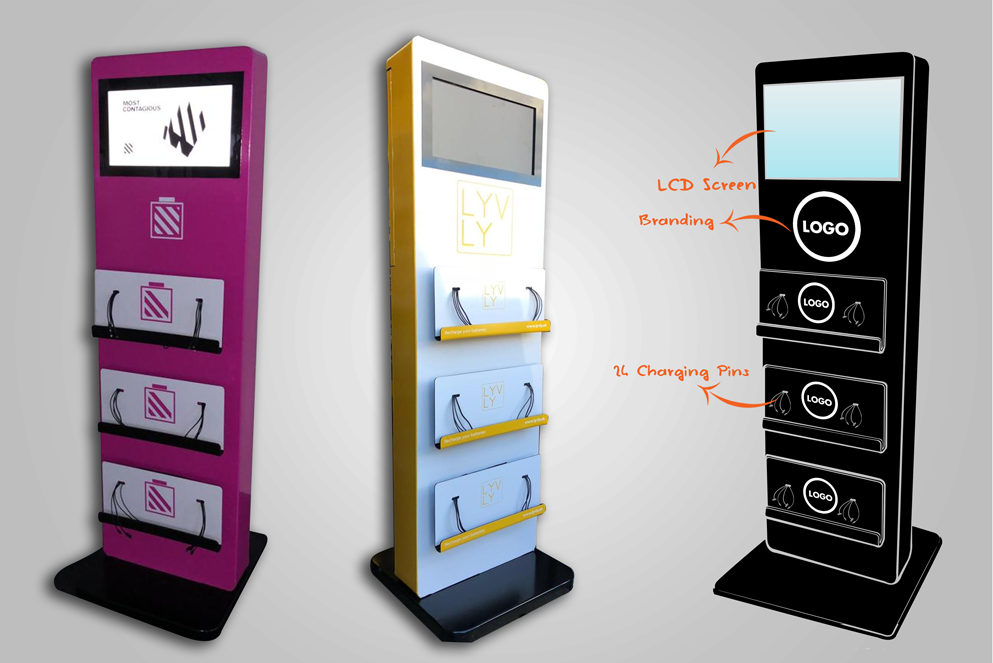
| Open phone charging stations | Conferences, exhibition stands, drop-in visitors who won’t leave a device unattended for long | Built-in cables charge the device while it stays with (or next to) the user | High — large flat surfaces front and back |
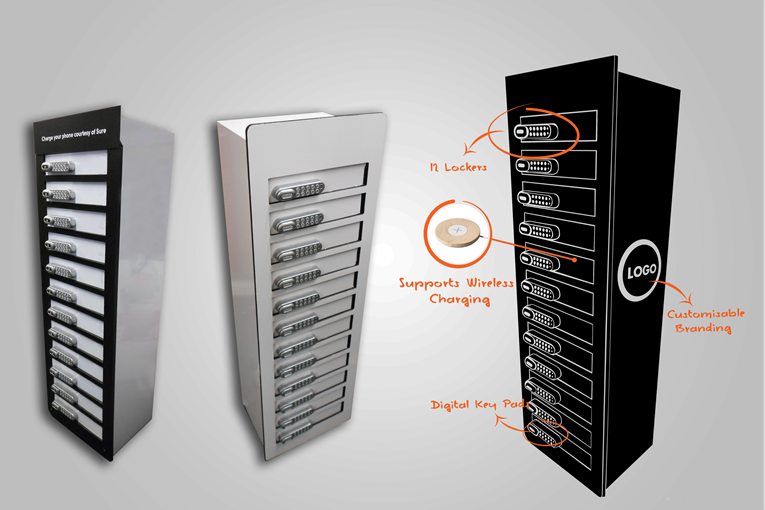
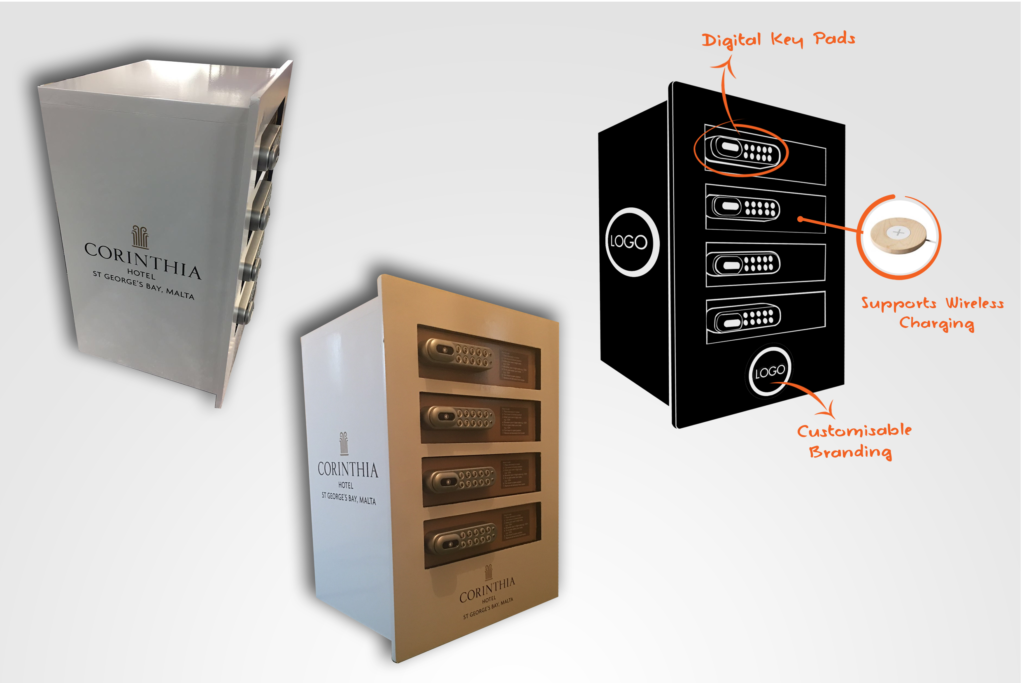
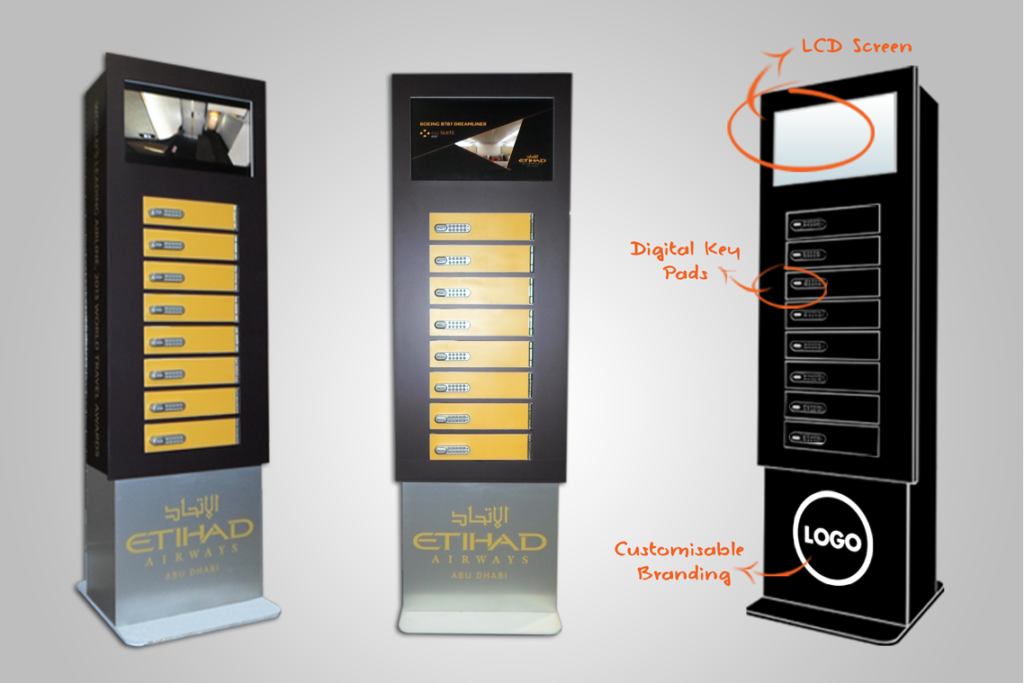
| Lockable charging lockers | Festivals, high-footfall public areas, cloakroom-style set-ups where devices are left unattended | Device is secured behind a door and released using a digital PIN the user sets themselves | High — door fronts and header panels are easily wrapped |
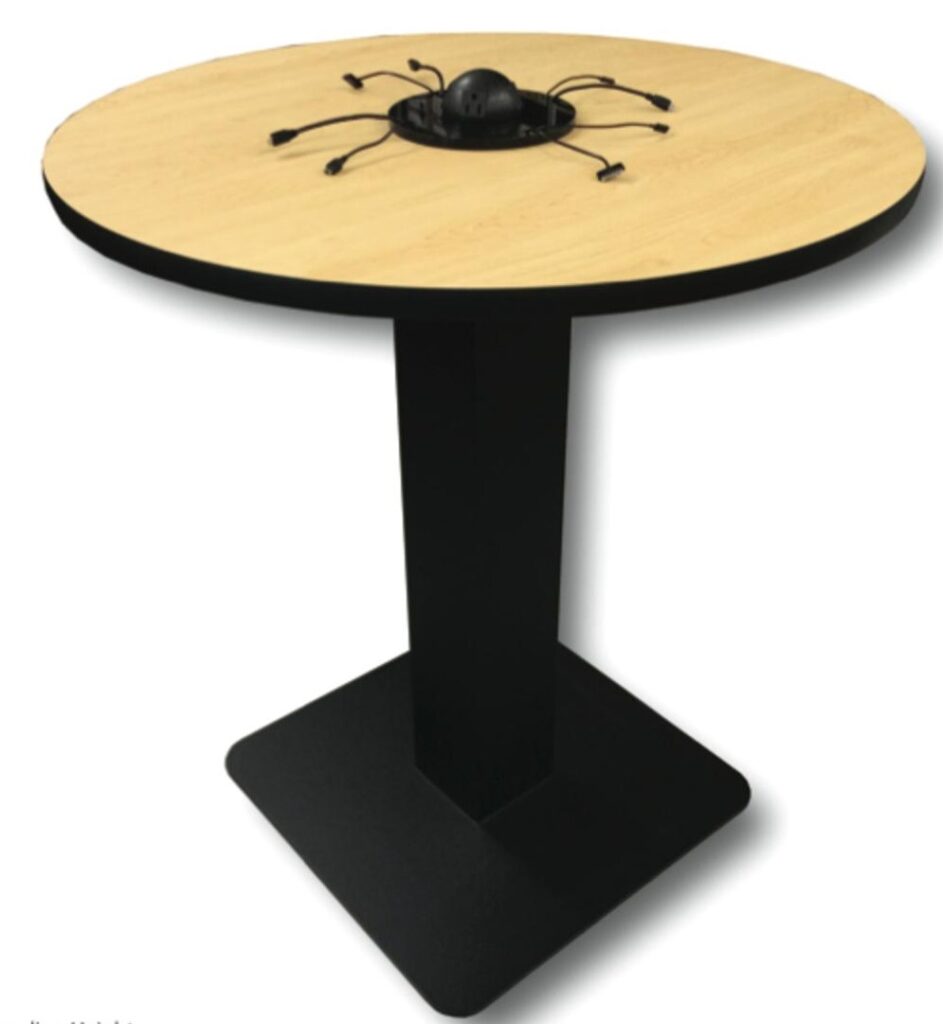
| Power tables | Networking areas, VIP lounges, hospitality zones | Wireless charging pads and USB cables built into a table surface that doubles as furniture | Moderate — branded table wrap, plaque or coaster-style inserts |
| Phone Charging kiosks | Airports, shopping centres, semi-permanent installations | Freestanding unit, often with an integrated LED screen for advertising, wayfinding or event information | Very high — screen content plus a full-wrap exterior |
For a Dublin exhibition stand at Convention Centre Dublin, open stations or a branded power table usually make the most sense — visitors want quick, visible access without queuing for a locker. For a festival or an unticketed public space, where a phone left charging unattended is a genuine risk, lockable lockers earn their keep.
Digital PIN phone charging lockers explained
The mechanics are deliberately unglamorous: a bank of small compartments, each with its own charging cable, secured by a keypad rather than a lock and key. A visitor puts a phone inside, closes the door, taps in whichever four-or-so digit code they like, and that code is now the only way back in. No wristband, no docket, no queueing at a desk to hand a device over to a stranger.
What that buys an organiser is mostly peace of mind at scale. Nobody on the events team ends up minding other people’s phones. Nobody needs training to operate it, because the system runs on codes the attendees choose themselves. And unlike an open charging point, a locker actually secures the device rather than simply powering it, which matters the moment a venue gets busy enough that nobody’s watching every unit. The one thing worth confirming with a supplier up front is how they handle a forgotten PIN — a proper engineer override should exist, but not every system implements it equally well.
Phone charging stations vs power banks: which suits your event
Portable power banks — the kind handed out at a registration desk or dispensed from a vending-style kiosk — solve a similar problem in a different way, and the two aren’t always interchangeable.
| Factor | Fixed charging stations / lockers | Power bank rental or giveaway |
|---|---|---|
| Brand visibility | Static, anchors attention at one fixed, plannable location | Mobile — travels with the user, but exposure is harder to predict or plan around |
| Security | Locker versions physically secure the device itself | Relies on deposit schemes or return kiosks; loss and non-return are a real cost |
| Dwell time | Draws people to a fixed spot for several minutes — genuinely useful for a sponsor stand | No dwell-time benefit; the value is purely the power bank’s own reach |
| Logistics | Delivered, installed and collected as a single fixed asset | Requires dispensing infrastructure, restocking and tracking across the site |
| Best suited to | Exhibition stands, conference venues, any fixed indoor location | Large, sprawling outdoor sites — festival campsites, city-wide activations |
Neither format is objectively “better” — a sprawling multi-day festival site often benefits from both, using power banks to cover distance and fixed lockers at key gathering points. For most conference, exhibition and corporate settings in Dublin, where the audience is contained within a hall or a stand, fixed stations tend to deliver the stronger return.
Technical specifications: cables, USB-C, Lightning and fast charging
The specification questions that come up most often are straightforward, and worth having clear answers to before a contract is signed rather than after the units arrive.
Cable compatibility is the first one. A well-specified unit should include built-in cables covering USB-C, Lightning and Micro-USB as standard, which between them cover the overwhelming majority of smartphones currently in circulation, whether the audience is mostly iPhone, mostly Android, or — as is typical at an international event like Pendulum Summit or SREcon EMEA — a genuine mix of both. Ask specifically whether older Micro-USB is still included; some newer fleets have started dropping it as fewer devices use it, which is usually fine but worth confirming if your audience skews toward older handsets or budget Android devices.
Charging speed is the second. Standard USB output is enough to top up a phone comfortably over the course of a typical charging session at an event, and most modern fleets also offer higher-output fast-charging ports for devices that support the faster protocol — useful in a conference setting where someone might only have ten minutes at the locker before their next session starts. Multi-device support varies by unit size: smaller stations handle a dozen or so simultaneous devices, while larger locker banks and kiosks scale up to several dozen.
Charging tablets and laptops, not just phones
Phones aren’t the only devices that run flat at an event. Press rooms, media centres, exhibition stands doing live product demos and any conference relying on delegate laptops all have the same problem at a larger scale, and dedicated tablet and laptop charging cabinets exist for exactly this reason.
The specification detail that matters most here is power delivery. A growing number of laptops — including most recent MacBooks and a large share of Windows ultrabooks — now charge over USB-C using the USB Power Delivery (USB-C PD) standard, which needs meaningfully more wattage per port than a phone does. When briefing a provider for a Dublin conference or exhibition stand that needs laptop charging specifically, it’s worth stating device types and quantities up front, since a locker bank sized for phones won’t necessarily have the port count or power budget to charge two dozen laptops at once.
Wireless charging tables
Power tables — flat surfaces with wireless Qi charging pads built into the top, usually alongside a few cabled ports for devices that don’t support wireless charging — tend to suit a different part of an event than lockers or open stations. They work best in networking areas, VIP lounges, sponsor hospitality zones and anywhere the aim is to keep people sitting and talking rather than queuing at a charging point.
Because a power table looks and functions like ordinary furniture, it fits more discreetly into a premium environment than a visibly branded locker bank would — useful for corporate events in Dublin where the charging function needs to be genuinely useful without dominating the room’s design. Branding is usually limited to a table wrap, a discreet plaque, or coaster-style inserts rather than a full exterior wrap, which is worth bearing in mind if maximum sponsor visibility is the priority rather than ambience.
Branding and customisation: making the hardware part of the sponsorship
Every format above can be branded, and branding is built into Vischarge’s rental service as standard rather than sold as a costly add-on — worth confirming with any provider, since it isn’t universal practice across the market. Typical options include full exterior wraps in a sponsor’s or event’s own colours and artwork, LED screens for rotating sponsor messages, agenda information or wayfinding, and a choice of wall-mounted, floor-standing or tabletop formats to fit whatever footprint a stand or venue actually has available.
For a Dublin exhibition stand at Convention Centre Dublin, floor space is usually the constraint, so it’s worth specifying dimensions early — a compact wall-mounted unit works where floor space is tight, while a floor-standing kiosk with a screen makes more sense where a stand has room to spare and wants the charging point to double as a focal display.
How branded phone charging stations become a sponsorship asset
Think about what an attendee actually does at most sponsor touchpoints: they glance, they walk past, they scan a badge and move on. A charging point is the rare exception where someone stops, has nowhere else to be for a few minutes, and is quietly grateful to whoever put the thing there in the first place. That combination — captive attention plus a slightly positive mood — is worth more to a sponsor than the hardware itself would suggest.
It’s why charging lounges increasingly show up as their own sponsorship tier rather than a freebie bundled into a bigger package. A sponsor gets their name on a locker bank at a busy crossing point in the hall, for a fraction of what a full stand would cost, and gets it in front of people who are staying put rather than passing through. Whether that translates into a measurable return usually comes down to what’s tracked alongside it — footfall at the location, QR scans, sign-ups through a linked form — rather than the branding on its own.
QR codes, data capture and lead generation
A QR code on the unit is the obvious next step: a link to a landing page, a competition, an app, or a short form, placed exactly where someone has a few free minutes and a phone already in hand.
Where this needs care is consent. Scanning a code out of curiosity while a phone charges is genuinely opt-in. Being told a locker won’t open unless a form gets filled in first is something else entirely, and it’s dealt with properly in its own section further down because it’s a point worth getting right rather than skating past. The QR code is an invitation sitting next to the service, not a condition attached to it.
GDPR and data protection considerations
Any data captured through a charging station — a QR scan, an email address, a competition entry — is personal data processing, and it needs a proper lawful basis under GDPR just as any other data capture mechanism at an event would.
A few points are worth building into the brief for any Dublin event before charging stations go live:
- Consent must be freely given. Making the return of someone’s own device conditional on a marketing opt-in is exactly the kind of pressured consent that GDPR’s Article 7(4) and Recital 42 are designed to prevent. Keep the charging service and any data capture entirely separate.
- Collect only what’s needed. A locker doesn’t need a user’s date of birth or job title to release a phone; a lead capture form linked via a QR code should ask only for what the sponsor genuinely intends to use.
- Be transparent at the point of collection. A short, clear privacy notice next to the QR code or sign-up form — what’s collected, why, and who it’s shared with — covers the basic transparency requirement.
- Check the processor arrangement. If a third-party platform handles the sign-up forms or analytics behind the QR codes, there should be a data processing agreement in place between the organiser (or sponsor) and that platform.
- Remember cross-border attendees. International events like Pendulum Summit and SREcon EMEA draw attendees from well over a hundred countries; UK GDPR may apply alongside EU GDPR where UK-based attendees’ data is involved, and it’s worth checking with your data protection adviser if the event’s data capture is more than trivial in scale.
None of this is unique to charging stations, but because the charging service itself is genuinely popular and well used, it’s an easy place for data capture volume to build up quickly without anyone stepping back to check the basics are covered.
Security, insurance and locking mechanisms
Three practical questions are worth asking any provider before signing a contract, and Dublin’s larger venues in particular — the CCD during a major conference like the Pendulum Summit, for instance — see enough footfall that the answers genuinely matter.
First, how is the locker secured, and is there a master override for lost PINs or technical faults? A properly specified digital PIN system should have an engineer-level override that doesn’t compromise security for other users. Second, what insurance does the provider carry, and what happens if a device is damaged or goes missing while charging? This is a fair question to ask directly and get a clear answer to in writing, rather than assuming it’s covered. Third, for events running across several days, is there someone on call if a unit develops a fault, or does a broken locker sit out of action until the hire period ends? On-site or on-call technical support during the event, rather than just at delivery and collection, is one of the clearer signals of a provider that’s set up to actually support events rather than just deliver hardware.
Accessibility
Charging infrastructure is one of the easier parts of an event to get right on accessibility, and one of the more commonly overlooked. A few practical points: locker banks should include compartments within reach for wheelchair users rather than placing every unit at standing height; keypads benefit from both tactile and high-contrast visual markings rather than a flush touchscreen alone; and open charging stations need enough clear approach space in front of them that a wheelchair or mobility aid can get close without navigating around trailing cables or a crowd.
Cable management matters for general safety too, not just accessibility — trailing cables across a walkway are a trip hazard regardless of who’s using the unit, and it’s worth confirming with a venue’s own health and safety team, particularly at a large hall like Convention Centre Dublin or the RDS, that unit placement has been checked against their layout requirements before delivery.
Sustainability
Shared, reusable charging infrastructure has a meaningfully lower environmental footprint per user than the alternative many events still default to: bulk-ordering disposable or giveaway power banks. A branded power bank handed out at registration is, in practice, usually used once, often lost or left behind, and contains a lithium battery that’s genuinely difficult to recycle responsibly if it ends up in general waste. A fleet of charging stations, by contrast, is manufactured once, used across dozens or hundreds of events over its working life, and professionally maintained rather than replaced.
It’s also worth noting that the CCD is the world’s first carbon-neutral convention venue and holds both ISO 14001 and ISO 20121 sustainability accreditations — a useful point of alignment for organisers who are being asked, increasingly often, to account for the environmental footprint of their event technology choices as part of a wider sustainability policy.
Delivery, installation and on-site support in Dublin
Vischarge delivers locally into Dublin as part of its wider European logistics network, with a typical lead time of two to fourteen days between booking and delivery — comfortably enough for planned events, and workable even for a genuinely late booking if the fleet has availability.
For exhibitions at Convention Centre Dublin or the RDS specifically, delivery and installation are usually scheduled to align with the venue’s own exhibitor move-in window, since both sites operate loading bay logistics and access schedules that every supplier needs to work within — a detail worth flagging to your Vischarge contact when booking, along with your exhibitor or stand number, so delivery can be coordinated directly with the venue rather than left to chance on the day. For hotel conferences, corporate offices and smaller venues without the same loading bay infrastructure, delivery is generally more straightforward and flexible on timing.
On-site installation is included as standard, and for larger or multi-day bookings, technical support is available for the duration of the event rather than only at drop-off and collection — the practical difference between a provider that delivers hardware and one that supports an event.
How rental pricing and duration work
Vischarge doesn’t publish a flat price list, for the same reason most event technology providers don’t: cost depends on a genuine combination of variables rather than a single day rate, and a fixed published number would be misleading for anyone whose event doesn’t match it exactly. The factors that actually move the price are:
- Duration — a single-day rate differs from a weekly or multi-week exhibition rate
- Unit type and quantity — open stations, lockers, power tables and kiosks are priced differently, and larger quantities typically bring the per-unit cost down
- Branding complexity — a simple single-colour wrap costs less than a full custom print with an integrated LED screen
- Delivery distance and access — a straightforward city-centre hotel delivery differs from a multi-day exhibition move-in at Convention Centre Dublin requiring scheduled loading bay access
- On-site support — whether an engineer is required on-site for the full event or simply on call
The most reliable way to get an accurate figure is to request a quote with these details to hand — expected attendee numbers, venue, dates and branding requirements — rather than working from a generic price estimate that won’t reflect your actual event.
Who uses phone charging station hire in Dublin (by sector)
Charging station hire in Dublin isn’t limited to the big technology exhibitions, even though Pendulum Summit and SREcon EMEA are the events most people think of first. In practice, demand comes from a much wider spread of venues and sectors:
- Exhibitions and trade shows — the CCD and the RDS between them host a steady year-round programme, from business summits and tech conferences to consumer shows like Dublin Comic Con
- Corporate conferences — company town halls, product launches and partner events across Silicon Docks, the IFSC and the city’s hotel conference space
- Festivals — St Patrick’s Festival alone brings enormous footfall into Dublin city centre each March, exactly the high-footfall, unattended-device scenario that lockable lockers are built for
- Universities — with institutions including Trinity College Dublin, University College Dublin and Dublin City University, campus events, graduations and open days are a recurring source of demand
- Retail and shopping centres — as a customer amenity rather than an event-specific booking
- Hotels — particularly those hosting MICE business given Dublin’s position as one of Europe’s most consistently ranked congress cities
- Sports and arena venues — Croke Park, Aviva Stadium and the 3Arena represent some of the highest single-day footfall events Dublin sees
- Airports — Dublin Airport sees substantial passenger volumes and represents a natural fit for semi-permanent charging kiosks
Most Dublin hire enquiries, in practice, are for considerably smaller corporate and trade events rather than CCD-filling shows — a reminder that “Dublin event” covers a much broader range than the headline names on the calendar.
Dwell time and attendee engagement
Behind all of this sits a small, well-documented piece of human psychology: a dying phone battery makes people genuinely anxious. LG Electronics’ consumer research on the subject found that close to nine in ten smartphone users felt a jolt of panic once their charge fell to 20% or below — since nicknamed “low battery anxiety” in marketing circles, though the underlying feeling is real enough. Whatever’s driving it, the effect on an event is predictable: someone with a dying phone goes and finds a charging point, and stays there until the problem’s solved.
That’s really all “dwell time” means in this context — not a clever engagement trick, just people waiting where they need to wait. A visitor who needs to charge a phone will do so regardless of the branding on the unit. What actually varies is whether that wait gets put to any use — a visible sponsor message, a QR code worth scanning, someone nearby worth talking to — or whether it just passes unremarked.
A provider evaluation checklist
It’s tempting to shop this on price alone, but price tells you almost nothing about whether a provider can actually deliver on the day. Better to run through this first:
- Are both open stations and lockable lockers available, so the format fits the venue rather than forcing a compromise?
- Is branding genuinely part of the package, with examples available to review beforehand?
- What cable types are built in as standard, and is fast charging offered?
- Is the quoted lead time realistic for your event date, with margin to spare?
- Does the price include installation, and is support available for the full length of the event?
- What’s the position if a device is damaged or lost while charging?
- Can the provider actually deliver into your venue, working around its loading bay and move-in schedule?
- If QR codes or data capture are planned, is there a clear, GDPR-compliant approach already agreed?
- Does the provider operate in other cities, in case future events need the same setup elsewhere?
- What’s the process for extending the hire once an event is already running?
Where Vischarge fits against that checklist
Checked against that list: Vischarge’s fleet includes open stations, lockable lockers, power tables and kiosks, so the format gets chosen for the venue rather than the venue having to make do. Branding is part of the standard service, not an extra. The stated lead time is two to fourteen days, and delivery reaches Dublin along with every other major European city, on the same fleet organisers can use for events elsewhere too. Vischarge also sells charging kiosks outright, for the smaller number of organisations wanting something permanently installed rather than event-based.
Beyond that, the real test of any provider comparison is the quote itself — measured against your actual venue, dates, unit count and branding needs, rather than against a general sales pitch.
Illustrative scenarios
The scenarios below are illustrative rather than specific past bookings — useful as a sense-check for the kind of setup that tends to work, rather than as named case studies.
A mid-size Dublin conference at the RDS. A two-day industry conference for around 800 delegates books a branded charging lounge as a headline sponsor benefit, positioned at the main networking break area. Open charging stations are used rather than lockers, since delegates want quick access between sessions rather than a locker-style drop-off. A QR code on each unit links to a short, clearly optional survey with a prize draw entry — kept entirely separate from the charging function itself.
An exhibition stand at the CCD. An exhibitor at a technology trade show hires a small bank of lockable charging lockers for their stand, aimed at visitors who want to browse the rest of the hall without carrying a phone. The lockers are wrapped in the exhibitor’s branding and double as a reason for visitors to return to the stand later in the day to collect their device.
A corporate offsite in Silicon Docks. A company running a two-day internal training event for 150 staff hires laptop and tablet charging cabinets alongside standard phone charging stations, specified with USB-C PD ports after confirming that most attendees would be bringing company-issued laptops that charge that way.
If you have a real event in mind, the team can talk through which of the formats above — or a combination — actually fits it, based on your venue, numbers and branding needs.
Booking process, step by step
- Outline the event — venue, dates, expected numbers, branding needs.
- Get a quote back tailored to that brief — unit type, quantity, branding, delivery.
- Approve the artwork — units are branded ahead of dispatch.
- Delivery and installation — coordinated around venue access, which matters particularly at the CCD and the RDS.
- Ongoing support — provided for the duration of larger or multi-day bookings.
- Collection — arranged around your move-out, nothing further required from you.
Maintenance and on-the-day support
Little undermines a multi-day event faster than a bank of charging lockers going dark halfway through. Before committing to a Dublin booking of any size, it’s worth pinning down exactly what happens if that occurs: whether there’s a direct contact for the event team, whether someone can be on-site within a set window, and whether a replacement unit genuinely exists rather than being promised in the abstract. Vischarge includes this as standard on larger bookings, but any provider should be able to answer the question specifically rather than reassuringly.
What’s next: smart lockers, hybrid events and AI-personalised charging
Charging infrastructure is a fairly mature category, but a few trends are worth watching. Hybrid events — where a portion of the audience attends remotely — are increasing the emphasis on charging for laptops and tablets rather than phones alone, since remote-facing staff and streaming equipment both draw down battery fast. Smart locker systems that integrate with an event’s own registration or badge-scanning app, rather than requiring a separate PIN, are becoming more common at larger tech-sector shows — fitting, given events like Pendulum Summit and SREcon EMEA are themselves showcases for exactly this kind of connected technology. And as AI-driven personalisation spreads through event technology generally — tailoring session recommendations, networking matches and on-site wayfinding to an individual attendee — it’s a reasonable bet that charging infrastructure eventually becomes another data point in that picture, rather than staying a purely physical amenity.
Phone charging station in Dublin Frequently Asked Questions
How much does it cost to hire a phone charging station in Dublin? Cost depends on several factors: how many units you need, whether you choose open stations, lockable lockers, power tables or kiosks, how complex the branding is, how long the hire runs for, and where in Dublin (or the wider region) you need delivery. A single-day hire of a handful of units for a small conference costs considerably less than a multi-week exhibition booking with dozens of fully branded lockers and an LED screen. Because of this range, Vischarge doesn’t publish a flat price list — the most useful next step is to request a quote with your event details so the figure reflects your actual event rather than a generic average.
How far in advance do I need to book charging station hire for a Dublin event? Vischarge’s typical lead time is two to fourteen days between booking and delivery, which covers most planned events comfortably. For anything happening during Pendulum Summit or SREcon EMEA week, when Convention Centre Dublin’s loading bays and the wider city’s logistics network are at their busiest, booking earlier rather than later is sensible simply to secure your preferred delivery slot — not because the fleet itself is likely to run short. For a genuinely last-minute requirement, it’s worth calling directly to check current availability rather than assuming it isn’t possible.
Do you deliver and install the charging stations, or do we set them up ourselves? Delivery and on-site installation are included as standard as part of the hire. For larger venues like Convention Centre Dublin or the RDS, installation is scheduled around the venue’s own exhibitor move-in window, and your Vischarge contact will usually ask for your stand or hall number to coordinate access directly with the venue. For smaller venues — a hotel conference room or an office, say — the process is more straightforward and flexible on timing.
What happens if a unit breaks down during our event? For larger and multi-day bookings, technical support is available for the duration of the hire, not just at delivery and collection. If a fault can’t be resolved on-site quickly, a replacement unit is arranged. It’s worth confirming the specific support arrangement — a direct phone line, on-site presence, or a stated response time — when booking, particularly for any event where downtime would be genuinely disruptive.
Can charging stations be branded with our own logo and colours? Yes — branding is included as standard rather than treated as a paid extra. Options range from a full exterior wrap in your own artwork through to an integrated LED screen for rotating messages, agenda information or sponsor content. Wall-mounted, floor-standing and tabletop formats are all available, so branding can be matched to whatever footprint your stand or venue has available.
What’s the difference between an open charging station and a locker? An open station charges a device using a built-in cable while it stays with, or next to, the user — quick and simple, but not suited to leaving a phone unattended. A locker secures the device behind a door, released using a digital PIN the user sets themselves, which suits situations where someone wants to walk away and browse a venue without carrying their phone. Conferences and exhibition stands often favour open stations for speed; festivals and unticketed public venues more often favour lockers for security.
Are digital PIN lockers difficult for attendees to use? No — the process is deliberately simple. The user places their device inside, closes the door, and sets their own PIN using a numeric keypad; retrieving the device just means entering the same PIN again. No app, account or staff assistance is needed. An engineer-level override exists for the rare case of a forgotten PIN or a technical fault.
What cable types are included — will it charge an iPhone and an Android phone? Standard units include built-in cables for USB-C, Lightning and Micro-USB, covering the large majority of smartphones currently in use — a genuine mix of iPhone and Android devices included. This matters particularly for an international audience, which is the norm at Dublin’s bigger shows like Pendulum Summit and SREcon EMEA, where attendees arrive with devices bought across dozens of different countries.
Can you charge laptops as well as phones? Yes — dedicated laptop and tablet charging cabinets are available alongside standard phone charging stations, specified with USB-C Power Delivery (USB-C PD) ports where needed, since most modern laptops that charge via USB-C need considerably more power per port than a phone does. If your event needs laptop charging specifically, it’s worth flagging device types and expected quantities when requesting a quote.
Do you offer wireless charging? Yes, on selected units — most commonly on power tables, which combine wireless Qi charging pads with a few cabled ports for devices that don’t support wireless charging. These suit networking areas, VIP lounges and hospitality zones better than a visibly branded locker bank would, since they look and function like ordinary furniture.
How many devices can one unit charge at once? This varies by format and size. Smaller open stations typically handle around a dozen devices simultaneously, while larger locker banks and kiosks scale up to several dozen. The right capacity depends on expected footfall and how long, on average, someone spends charging — worth discussing when requesting a quote so the unit count matches your actual attendee numbers rather than a rough guess.
Is there a minimum hire period? Hire periods typically start from a single day, making the service viable for a one-day conference or product launch as well as multi-week exhibitions. There’s no requirement to commit to a longer period than your event actually needs.
Do I need my own power supply, or do the units bring their own? Units connect to a standard mains power supply at the venue — this is confirmed and arranged as part of the delivery and installation process, so it’s not something your team needs to organise separately, beyond making sure the venue itself has the necessary power points available near the agreed installation location.
What happens to the data if we use QR codes or lead capture forms on the lockers? Any data collected via a QR code or sign-up form is personal data processing under GDPR, and responsibility for that data sits with whoever collects it — typically the event organiser or sponsor running the campaign, rather than the charging station provider itself. It’s worth confirming this responsibility explicitly, along with a clear, GDPR-compliant approach to consent, before launching any data capture activity alongside the charging stations. Crucially, access to the charging service itself should never be made conditional on completing a form or opting into marketing.
Are the charging stations insured? Insurance arrangements are worth confirming directly and in writing with whichever provider you use, covering both the units themselves and liability for devices left charging. This is a fair and standard question to ask before signing any hire contract, rather than assuming cover exists.
What if a phone is damaged while charging? This should be covered under the provider’s liability arrangements, and it’s worth getting written clarity on this specific scenario before the event — what’s covered, what isn’t, and what the claims process looks like — rather than discovering the answer only if something goes wrong on the day.
Can you deliver to Convention Centre Dublin or the RDS directly? Yes. Delivery and installation at Dublin’s major venues are scheduled around the venue’s own exhibitor move-in window and loading bay access, which every supplier has to work within. Providing your stand, hall or booking reference when you book allows delivery to be coordinated directly with the venue rather than left to chance on the day.
Do you provide on-site staff or an engineer during the event? For larger and multi-day bookings, technical support is available for the duration of the hire, either on-site or on call depending on the scale of the event. For smaller, single-day bookings, support is typically provided remotely with a clear point of contact, since the likelihood of an issue is correspondingly lower.
Is phone charging station hire suitable for outdoor events? Yes, with the right unit specification — outdoor-rated units and appropriate weatherproofing are available for festivals and open-air events, and it’s worth flagging that the event is outdoors when requesting a quote so the correct equipment, rather than a standard indoor unit, is proposed.
How accessible are the lockers for wheelchair users? Well-specified locker banks include compartments at a reachable height for wheelchair users rather than positioning every unit at standing height, along with keypads that combine tactile and high-contrast visual markings. It’s a fair and increasingly common request to make explicitly when booking, particularly for public-facing events, and worth confirming directly rather than assuming it’s automatically covered.
Can we hire just a few units for a small meeting, or is this only for large exhibitions? Hire is available at any scale, from a handful of units for a small meeting or internal training day through to large multi-day exhibition bookings running into hundreds of units. The logistics and quote process scale with the booking rather than requiring a minimum order aimed at large events only.
What’s the environmental impact compared to giving out power banks? Shared, reusable charging infrastructure generally has a lower environmental footprint per user than distributing disposable or giveaway power banks, which are often used once, frequently lost or abandoned, and contain lithium batteries that are difficult to recycle responsibly outside a proper collection scheme. A rental fleet, by contrast, is manufactured once and reused across many events over its working life, with maintenance built into the service rather than the unit being replaced.
Can Vischarge deliver to other Spanish or European cities as well as Dublin? Yes — delivery covers Dublin alongside every other major European city, using the same European-wide logistics network and the same rental fleet. This is useful for organisers or agencies running a touring conference series or multiple activations across different markets, since the branding, unit specification and provider relationship can stay consistent from city to city.
How do we get a quote? Get in touch with your event details — venue, dates, expected footfall, unit type preference and any branding requirements — and the team will put together a tailored quote based on those specifics, rather than a generic estimate.
Can charging stations double up as advertising screens? Yes — kiosks and larger locker banks are available with integrated LED screens capable of displaying rotating sponsor advertising, agenda information, wayfinding or event announcements, turning the charging point into a small piece of on-site digital signage as well as a functional amenity.
What’s the lead time if we need something urgently, at short notice? The stated typical lead time is two to fourteen days, but fleet availability at short notice does vary by date and by how much equipment your event needs — it’s worth calling directly to check rather than assuming a last-minute request can’t be accommodated. Being flexible on unit type (for example, accepting whatever open stations are available rather than insisting on lockable lockers specifically) can also make a tighter turnaround easier to fulfil.
Glossary
- Charging locker — A lockable compartment that secures a device while it charges, opened and closed via a digital PIN or key.
- Digital PIN lock — A keypad-based locking mechanism where the user sets their own access code rather than being issued a key.
- Power table — A table incorporating wireless and/or cabled charging points, designed to double as event furniture.
- Charging kiosk — A freestanding charging unit, often incorporating an LED screen for advertising or information display.
- Dwell time — The length of time a visitor spends at a particular location within an event or venue.
- MICE — Meetings, Incentives, Conferences and Exhibitions; the industry term for the broader business events sector.
- Activation — A branded, experiential marketing installation at an event, designed to actively engage attendees rather than simply display a logo.
- Lead generation — The process of capturing contact details or engagement data from event attendees for follow-up marketing or sales purposes.
- USB-C PD (Power Delivery) — A charging standard allowing higher power output over a USB-C cable, used by most modern laptops that charge via USB-C.
- Qi charging — The industry-standard wireless charging protocol used by most modern smartphones and wireless charging pads.
- Footfall — The number of people passing through or visiting a particular location or event.
Ready to hire phone charging stations for your Dublin event?
Vischarge operates Europe’s largest rental fleet of phone charging stations — more than 5,000 units, delivered locally into Dublin and every other major European city, with branding built into the service as standard and technical support available for the full duration of larger bookings. Whether you’re planning a stand at the CCD, a conference at the RDS, a corporate event in Silicon Docks, or a festival anywhere across Ireland, the team can put together a tailored quote based on your venue, dates, footfall and branding requirements.
Get in touch to discuss your event and request a quote — the sooner the details are in, the more accurately the quote, and the delivery schedule, can reflect what your event actually needs.